
Denise Stegall · October 26, 2026
Joint Supplements in Menopause: What the Science Says
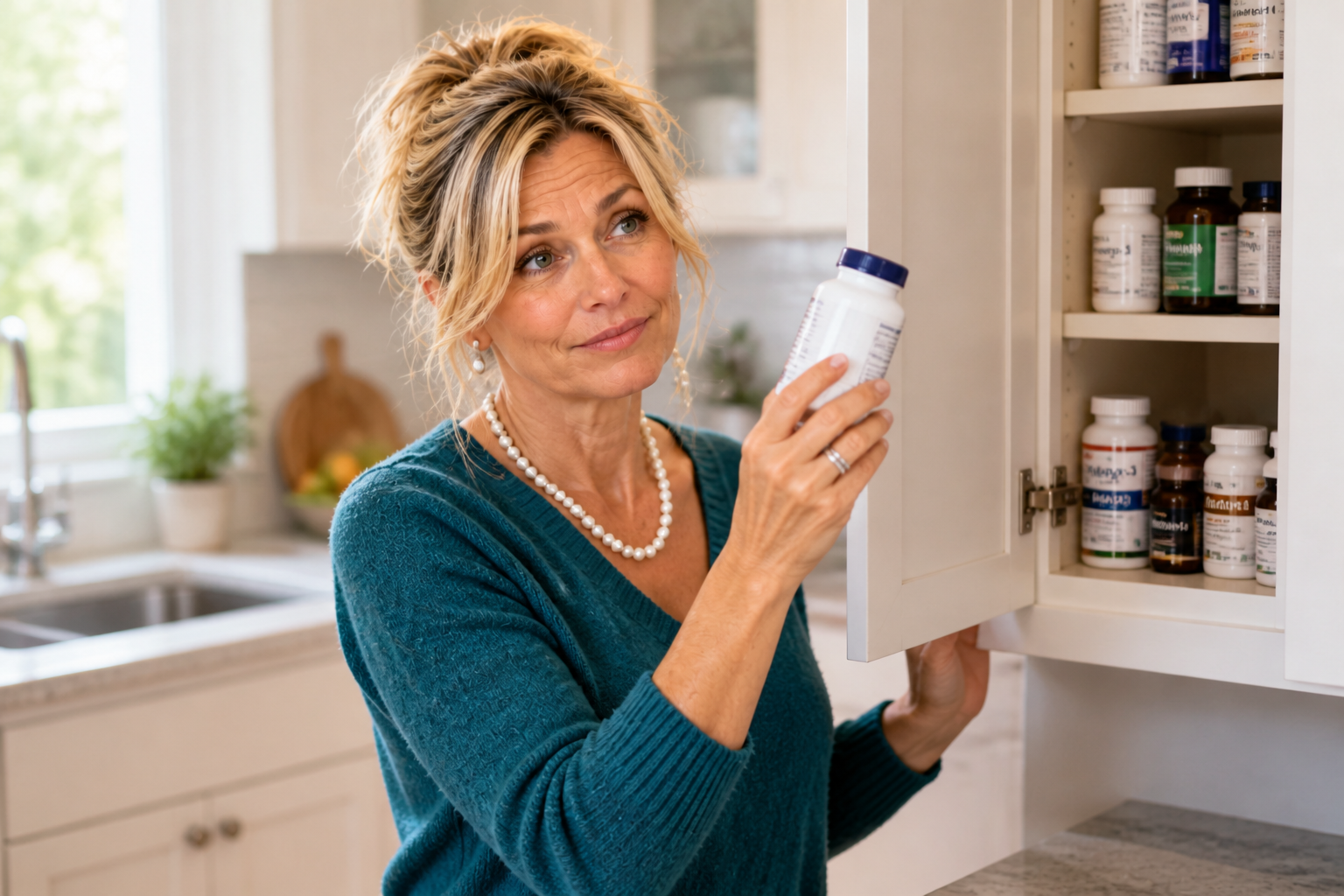
Achy joints are one of the most common complaints of the menopause transition, and the supplement aisle has an answer for every one of them. Some of those answers hold up better than others. Here's what the research actually shows, why the evidence is so mixed, and how to make a clear decision about what belongs in your cabinet.
Open the cabinet above your coffee maker and count the bottles. If you're like many of the women I work with, at least one or two of them promised to do something for your joints.
Perhaps it's collagen powder in your morning coffee, turmeric with black pepper, a fish oil capsule or a "joint complex" with a long list of ingredients. You started them because your knees were stiff on the stairs, your hands ached in the morning or a workout you've done for years suddenly left you sore for days.
That makes complete sense. Musculoskeletal symptoms are remarkably common during the menopause transition. A 2024 review that proposed the term musculoskeletal syndrome of menopause estimated that more than 70% of women experience musculoskeletal symptoms as they move from perimenopause into postmenopause. PubMed
If you'd like to understand why estrogen, sleep, stress and muscle all play a role, I covered that in Menopause and Joint Pain: Why Your Body Aches in Midlife. This article picks up where that one left off, with the question so many women ask next:
Are the supplements I'm taking actually doing anything?
Why supplement research is harder to interpret than it looks
Before we look at individual supplements, it helps to understand three things about how this research is done. They explain why you can find a headline supporting almost any product.
Most of the research isn't about menopause
The large majority of joint supplement trials enroll people with diagnosed knee osteoarthritis, often in their 60s and older. Very few have studied the joint pain, morning stiffness and muscle aches that appear during perimenopause specifically.
When researchers conducted a systematic review of complementary therapies to inform the International Menopause Society's updated recommendations on midlife health, they concluded that more rigorous research is needed on both the efficacy and safety of these therapies for menopause. Western Sydney University
That doesn't make the osteoarthritis research irrelevant. It does mean we're borrowing evidence from a somewhat different population, so it's worth holding conclusions a little loosely.
The placebo response in joint pain trials is strong
Pain is subjective, and it fluctuates. In joint pain trials, a substantial share of people taking a placebo report meaningful improvement. In the largest U.S. glucosamine trial, for example, about 54% of participants with moderate to severe knee pain who took a placebo had at least a 20% reduction in pain. PubMed
This matters because it means a supplement has to beat a fairly high bar. It also means that when you feel better after starting something new, it's genuinely hard to know whether the supplement is responsible.
"Turmeric" in one study isn't the same as "turmeric" in another
Trials use different forms, doses and formulations, and many are small, short or funded by the ingredient's manufacturer. When reviewers combine those studies, the results often vary widely from one trial to the next. That variability is a big reason so many reviews end with "promising, but more research is needed."
With that context, let's look at the evidence.
Collagen: modest benefit, but it isn't rebuilding cartilage
How it's supposed to work
Collagen is the main structural protein in cartilage, tendons, ligaments and bone, so it's easy to assume that eating collagen sends it straight to your joints. That isn't how digestion works.
Hydrolyzed collagen (collagen peptides) is broken down into amino acids and small peptide fragments. Researchers have proposed that some of those absorbed fragments may act as signaling molecules in joint tissues. Even so, that is very different from an ingested supplement becoming new cartilage. South First
A different form, undenatured type II collagen (often sold as UC-II), is taken in much smaller doses and is thought to work through the immune system rather than as a building block.
What the research shows
The collagen research has become more encouraging over the last several years. A large 2024 meta-analysis in Osteoarthritis and Cartilage pooled 35 randomized trials with 3,165 participants and found small-to-moderate improvements in pain and physical function with collagen derivatives compared with control treatments. South First
Another 2024 meta-analysis of 11 trials also found improvements in both pain and function scores. PubMed
The caveats are real, though. A 2023 analysis of collagen peptide trials found significant pain relief, but judged all four included trials to have a high risk of bias. PubMed An earlier 2019 meta-analysis found improvement in stiffness but not in the pain or function subscores of the main osteoarthritis questionnaire. PubMed
Early research on UC-II looks promising, but it is based on a small number of trials. PubMed
My take
Collagen is a reasonable, generally well-tolerated option to trial if you're curious. Expect modest symptom relief at best, not repair.
One nutrition note: collagen is an incomplete protein. It lacks tryptophan and is low in leucine, the amino acid most associated with stimulating muscle protein synthesis. A scoop of collagen in your coffee doesn't replace the protein your muscles need from meals, and in midlife, your muscles do much of the work of protecting your joints.
Turmeric and curcumin: some of the better evidence, and real safety concerns
How it's supposed to work
Curcumin is the main active compound in turmeric root. In laboratory research, it inhibits NF-κB, a protein complex that switches on many inflammatory genes. It also dampens COX-2, the same inflammatory enzyme targeted by many over-the-counter pain relievers, and lowers inflammatory messengers such as TNF-α and IL-6. Hull Repository
The challenge is getting it into your bloodstream. Plain curcumin is very poorly absorbed, and much of it is rapidly processed by the liver and gut. That's why so many products add black pepper extract (piperine), which slows the body's breakdown of curcumin and substantially increases blood levels. Frontiers in Immunology
Hold on to that detail. It becomes important in the safety section.
What the research shows
For knee osteoarthritis, curcumin has some of the more consistent evidence among joint supplements. A 2024 umbrella analysis that combined 11 earlier meta-analyses found that curcumin significantly reduced pain scores and improved osteoarthritis questionnaire scores. Nutrition Evidence
That said, an Oxford review found that while curcuminoids may help knee pain and quality of life, they were less effective than ibuprofen. University of Oxford A 2025 critical review also pointed to inconsistent study quality, small sample sizes and widely varying outcomes across the research. Frontiers in Pharmacology
The safety side
The National Institutes of Health's LiverTox database lists turmeric as a known cause of clinically apparent liver injury. These cases are rare, but they are well documented. NCBI Bookshelf
According to liver specialists involved in the NIH-funded Drug-Induced Liver Injury Network, many cases have involved products containing black pepper extract. The same piperine that boosts curcumin absorption also inhibits enzymes and transporters that process many prescription medications, which can raise the levels of those drugs in your body.
Curcumin also has antiplatelet effects, so it may increase bleeding risk alongside blood thinners and anti-platelet medications. It stimulates bile flow and is generally not recommended for people with gallbladder obstruction. One published case report described liver injury in a woman taking turmeric supplements for rheumatoid arthritis along with semaglutide, raising questions about interactions that haven't been well studied in humans. MOspace
Culinary turmeric is a very different exposure from a concentrated extract taken daily.
My take
Curcumin may be worth discussing with your provider, particularly for knee pain. If you take any prescription medication, ask your pharmacist about interactions before starting, and be especially cautious with piperine-containing products. Stop and seek care if you notice unusual fatigue, dark urine, yellowing of the skin or eyes, nausea or pain under your right ribs.
Glucosamine and chondroitin: the biggest trial came up mostly empty
How it's supposed to work
Glucosamine and chondroitin are natural components of cartilage. The theory is that supplementing them supports the cells that maintain cartilage structure and may slow its breakdown. Arthritis Foundation
What the research shows
The most rigorous U.S. test was the NIH-funded Glucosamine/Chondroitin Arthritis Intervention Trial (GAIT), published in the New England Journal of Medicine in 2006. It randomized 1,583 people with knee osteoarthritis, 64% of them women, to glucosamine, chondroitin, both, the prescription anti-inflammatory celecoxib, or placebo for 24 weeks. Epistemonikos
Overall, glucosamine and chondroitin, alone or together, did not significantly reduce knee pain compared with placebo.
There was an intriguing exception. Among participants with moderate to severe pain, about 79% taking the combination had at least a 20% reduction in pain, compared with about 54% on placebo. PubMed: Because this was an exploratory subgroup, it suggests a possibility rather than proving a benefit.
Since GAIT, the research has remained mixed. Some experts point out that GAIT used glucosamine hydrochloride, and argue that glucosamine sulfate performs better. A 2016 multinational trial (MOVES) found the combination comparable to celecoxib for knee pain and swelling. Meanwhile, the National Center for Complementary and Integrative Health describes the evidence for glucosamine as unclear and chondroitin as not helpful, while noting that neither has been shown to be harmful. Arthritis Foundation
Importantly, no conclusive evidence shows that either supplement prevents or reverses the joint degeneration of osteoarthritis. Arthritis-health
My take
If you've taken glucosamine for months and can't tell a difference, you may have your answer. If you have more significant knee pain and want to try it, glucosamine sulfate is the form with the stronger supporting argument. Many products are derived from shellfish, so check the source if you have an allergy, and talk with your provider if you take a blood thinner.
Vitamin D and fish oil: important nutrients, but not joint pain solutions
How they're supposed to work
Vitamin D is involved in bone and muscle health, and observational studies have linked low vitamin D levels with greater knee pain. Omega-3 fatty acids from fish oil are precursors to compounds that help resolve inflammation. On paper, both make sense.
What the research shows
The VITamin D and OmegA-3 TriaL (VITAL) provided one of the most rigorous tests. Within this large national trial, researchers followed 1,398 adults with chronic, frequent knee pain, 66% of them women, for an average of 5.3 years. Participants took 2,000 IU of vitamin D3, about 1 gram of marine omega-3s, both, or placebo. HCPLive
Neither vitamin D nor fish oil reduced knee pain, stiffness or loss of function compared with placebo, at any point during follow-up. PubMed
Earlier vitamin D trials found much the same. A two-year trial published in JAMA in 2013 raised participants' vitamin D levels well into the sufficient range, yet found no meaningful difference in knee pain or cartilage loss compared with placebo. American Family Physician A 2016 JAMA trial in 413 people with knee osteoarthritis and low vitamin D levels also found no significant effect on knee pain or cartilage volume over two years. RheumNow
My take
This doesn't mean vitamin D is unimportant. Bone health becomes a much bigger priority as estrogen declines, and many women are genuinely low. The better approach is to ask your provider to test your level rather than guessing, and to correct a deficiency for your bones' sake, even if your knees don't notice a difference.
The same goes for fish oil. It may have other benefits, and eating oily fish regularly is part of the Mediterranean-style eating pattern most strongly supported for midlife health. It just isn't a reliable remedy for joint pain.
Why the "joint complex" stack can backfire
One of the most common patterns I see is the stack: several joint products started within a few weeks of one another.
It's an understandable approach for a busy, capable woman who wants to feel better fast. But it creates three problems.
You can't tell what's working. If you start five things at once and feel better, you won't know which one helped, or whether it was the placebo response, a better night's sleep or the walks you started at the same time.
Interaction risk adds up. Each added product increases the chance of an interaction with your medications or with another supplement. Turmeric with piperine is a good example, since piperine can affect how you process a wide range of prescription drugs.
Blends often underdose. Multi-ingredient "joint complex" products frequently contain small amounts of many ingredients, sometimes less than the doses used in the trials that made those ingredients look promising.
It's also worth remembering that in the United States, supplements do not need to be proven effective before they are sold. An independent quality seal, such as USP Verified or NSF Certified, at least tells you the bottle contains what the label says and isn't contaminated.
How to decide what's worth your money
You don't need to throw everything away. You need a clear way to evaluate it.
Define what you want it to change. "My hands are stiff for the first hour every morning" is measurable. "Support joint health" isn't.
Check for interactions first. Bring the bottle, or a photo of the label, to your pharmacist or healthcare provider. This matters most if you take blood thinners, blood pressure medications, diabetes medications, GLP-1 medications or migraine treatments.
Trial one thing at a time. Give a single new supplement 8 to 12 weeks. A few times a week, jot down your pain, stiffness, sleep and what you were able to do. If nothing has changed by the end of that window, you have useful information.
Test instead of guessing when you can. Vitamin D is the clearest example. Knowing your level tells you whether supplementing makes sense.
Build the foundation first. No capsule compensates for skipped meals, too little protein, poor sleep or muscles that aren't being challenged. Strength training remains one of the best-supported strategies for protecting painful joints, and research suggests lower-intensity strength work can be as effective as high-intensity training for knee pain. CSPI
Clarity is worth more than another bottle
I'll give you an example from my practice. One client, whom I'll call Michelle, came to our first session with a photo of her supplement cabinet: collagen, turmeric with black pepper, fish oil, glucosamine and a joint blend. She was spending well over $100 a month and had no idea what was helping.
We paused nearly everything. Her vitamin D test came back low, so that stayed. With her pharmacist's approval, she trialed curcumin alone. She also added protein at breakfast and two short strength sessions each week.
Twelve weeks later, her notes showed that her knees felt noticeably better on the days after strength work. Her morning hand stiffness remained, which led to a more productive conversation with her doctor. She also cut her supplement spending by more than half.
That's what clarity looks like. Not a perfect answer, but a plan you can actually evaluate.
Michelle is a composite based on common client experiences; names and details have been changed.
Ready to stop guessing?
If your cabinet looks a little like Michelle's, my Hormone Clarity Session is designed to help you sort through it.
Before we meet, you'll complete my Hormone Clarity Tool so I can see the patterns behind your symptoms, from joint pain and stiffness to sleep, energy and mood. Then we'll spend 60 minutes together focused on what matters most to you. Bring your supplement list and any recent lab results, and we'll talk through what deserves your money and what doesn't.
You'll leave with a personalized 30-day plan and a follow-up call already on the calendar.
Book Your Hormone Clarity Session
Connect the dots. Understand your body. Know what to do next.
References
Wright VJ, Schwartzman JD, Itinoche R, Wittstein J. The musculoskeletal syndrome of menopause. Climacteric. 2024;27(5):466–472. PubMed
Maunder A, et al. Complementary therapies for management of menopausal symptoms: a systematic review to inform the update of the International Menopause Society recommendations on women's midlife health. Climacteric. 2026. Western Sydney University
Simental-Mendía M, et al. Effect of collagen supplementation on knee osteoarthritis: an updated systematic review and meta-analysis of randomised controlled trials. Clin Exp Rheumatol. 2024. PubMed
Lin CR, et al. Analgesic efficacy of collagen peptide in knee osteoarthritis: a meta-analysis of randomized controlled trials. J Orthop Surg Res. 2023. PubMed
García-Coronado JM, et al. Effect of collagen supplementation on osteoarthritis symptoms: a meta-analysis of randomized placebo-controlled trials. Int Orthop. 2019;43(3):531–538. PubMed
Efficacy of undenatured collagen in knee osteoarthritis: review of the literature with limited meta-analysis. Am J Transl Res. 2023;15(9):5545–5555. PubMed
Jamilian P, et al. The efficacy of curcumin in relieving osteoarthritis: a meta-analysis of meta-analyses. Phytother Res. 2024;38(6):2875–2891. PubMed
Onakpoya IJ, Spencer EA, Perera R, Heneghan CJ. Effectiveness of curcuminoids in the treatment of knee osteoarthritis: a systematic review and meta-analysis of randomized clinical trials. University of Oxford
A critical review of systematic reviews and meta-analyses of curcumin for knee osteoarthritis. Front Pharmacol. 2025. Frontiers
National Institutes of Health. LiverTox: Turmeric. NCBI Bookshelf
Zhang E, Poltiyelova E, Rezvani M. Turmeric-induced liver injury in a patient with concurrent semaglutide use. Am J Hosp Med. 2024. MOspace
Clegg DO, et al. Glucosamine, chondroitin sulfate, and the two in combination for painful knee osteoarthritis. N Engl J Med. 2006. Epistemonikos
The NIH Glucosamine/Chondroitin Arthritis Intervention Trial (GAIT). J Pain Palliat Care Pharmacother. 2008;22(1):39–43. PubMed
MacFarlane LA, et al. The effects of vitamin D and marine omega-3 fatty acid supplementation on chronic knee pain in older U.S. adults: results from a randomized trial. Arthritis Rheumatol. 2020;72(11):1836–1844. PubMed
McAlindon T, et al. Effect of vitamin D supplementation on progression of knee pain and cartilage volume loss in patients with symptomatic osteoarthritis. JAMA. 2013;309(2):155–162. American Family Physician summary
Arthritis Foundation. Glucosamine and Chondroitin for Osteoarthritis Pain. Arthritis Foundation