
Denise Stegall · November 11, 2026
Bioidentical hormones vs HRT vs MHT

Bioidentical, HRT, MHT, compounded: the labels around menopause hormone therapy can make one decision feel like ten. Here's what each term means, what the evidence says as of November 2026, and the questions that help you decide with your provider.
You asked your doctor about HRT and heard, "We call it hormone therapy now." A clinic down the road advertises natural bioidentical hormones. A friend swears by her pellets. And your pharmacist just told you your estradiol patch is backordered.
If you're wondering whether these are all the same thing, it's something I hear from women all the time. The short answer: some of these words name the treatment, one describes the molecule, and one describes how the product is made. Once you can tell them apart, your options get much clearer.
What's the difference between HRT, MHT and hormone therapy?
They are largely the same treatment under different names.
HRT (hormone replacement therapy) is the older term, still common in the UK and in everyday conversation.
MHT (menopausal hormone therapy) appears in research and in recent FDA communications.
HT (hormone therapy) is the term many U.S. menopause specialists prefer.
The move away from "replacement" is intentional. As Dr. Nanette Santoro of the University of Colorado has explained, most providers now avoid the word because it suggests that women without estrogen are deficient. "Hormone therapy" frames the treatment as symptom relief during a natural transition, not a correction of something broken.
Systemic hormone therapy means estrogen, plus a progestogen if you have a uterus, to protect the uterine lining. Low-dose vaginal estrogen is a separate, local treatment for vaginal and urinary symptoms.
What does "bioidentical" actually mean?
"Bioidentical" describes a hormone's chemical structure. A bioidentical hormone is identical to one your body makes, such as estradiol or progesterone. The National Academies of Sciences, Engineering, and Medicine uses this definition and notes that bioidentical hormones come both as FDA-approved products and as compounded preparations.
The term does not tell you where a hormone came from, whether it is FDA-approved, or whether it is safer. Those are separate questions.
Are bioidentical hormones natural?
Not in the way the word suggests. Bioidentical hormones are synthesized in a laboratory, typically from a plant compound (diosgenin) that is extracted from yams or soy and then chemically converted. A Cleveland Clinic Journal of Medicine review points out that all the hormones used in therapy are man-made, which makes "bioidentical vs. synthetic" a misleading comparison.
The reverse is true, too: natural does not mean bioidentical. Conjugated equine estrogens (Premarin) come from the urine of pregnant mares. They are natural in origin but include estrogens the human body doesn't make.
Are bioidentical hormones FDA-approved?
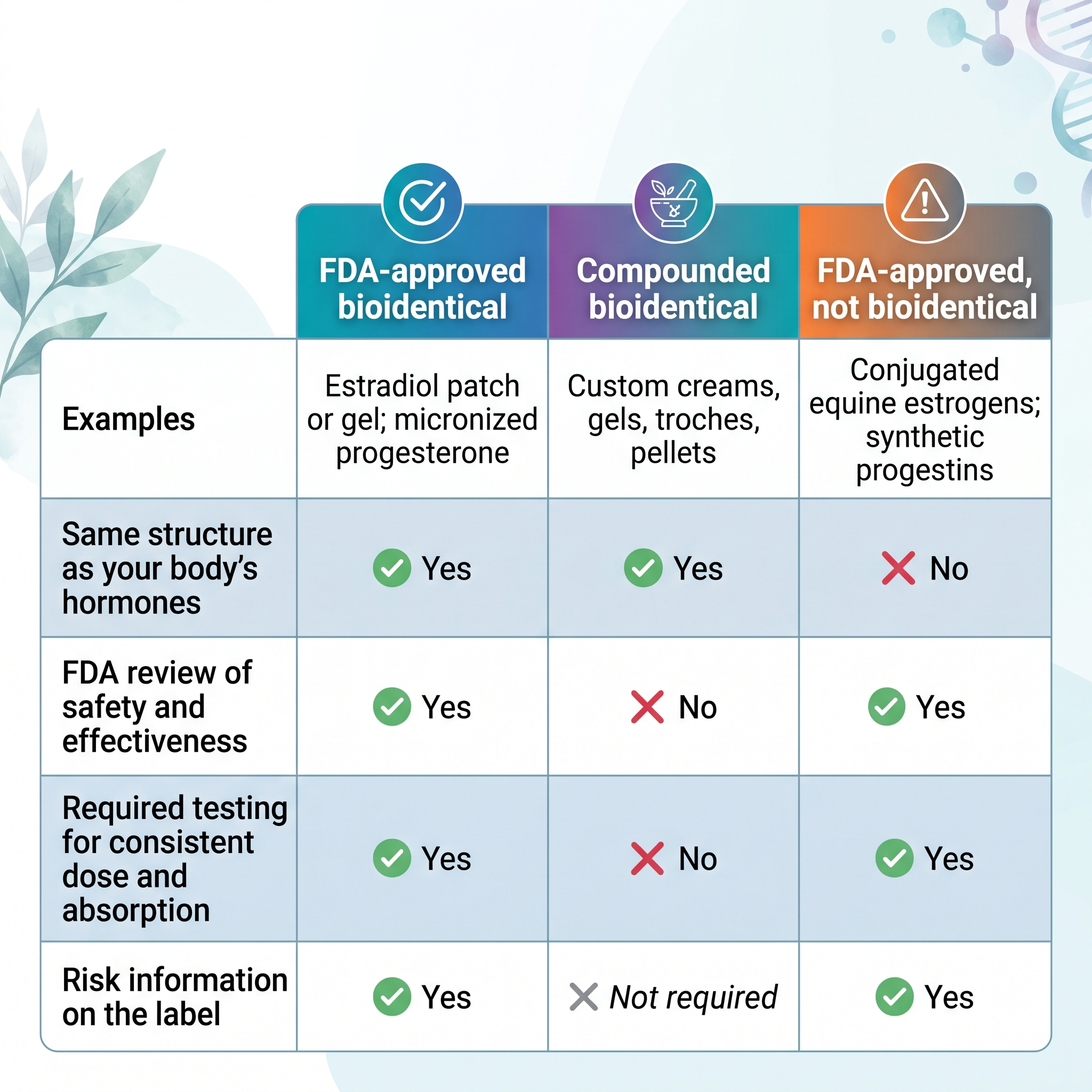
Many are. FDA-approved bioidentical options include:
Estradiol patches, gels, sprays and tablets
Vaginal estradiol (rings, tablets and creams) for local symptoms
Micronized progesterone capsules (Prometrium)
A combined estradiol and progesterone capsule (Bijuva)
Prometrium and Bijuva were among the first six products to receive updated FDA labeling in February 2026.
What are compounded bioidentical hormones, and are they safer?
A compounding pharmacy prepares these products to order for an individual prescription, often as creams, gels, troches or pellets. They may contain bioidentical molecules, but the finished product isn't FDA-approved.
They're widely used. A 2015 study in Menopause estimated that 1 to 2.5 million U.S. women aged 40 and older use compounded hormone therapy, and 86% of women surveyed didn't know these products aren't FDA-approved.
The evidence does not support claims that compounded hormones are safer or more effective:
The National Academies' 2020 report, requested by the FDA, found insufficient evidence to support the clinical utility of compounded bioidentical hormones. It recommended limiting their use to people who cannot use an FDA-approved product, for example because of an allergy or a needed dose that isn't available.
The Menopause Society's 2022 position statement lists safety concerns including minimal regulation and monitoring, overdosing or underdosing, possible impurities, limited safety and efficacy data, and no label outlining risks.
Compounding still has a legitimate role. The FDA-approved progesterone capsule contains peanut oil, so a compounded version can make sense for a patient who is allergic to peanuts.
What about hormone pellets and progesterone creams?
Pellets are compounded hormones, usually estradiol, testosterone or both, placed beneath the skin and absorbed over three to six months. Once inserted, they can't be removed. A 2021 study in Menopause compared 384 women using pellets with 155 using FDA-approved therapy. The pellet group had markedly higher estradiol and testosterone levels and reported side effects about four times as often (58% vs. 15%). In women who still had a uterus, abnormal bleeding occurred in 55% of the pellet group versus 15% of the comparison group. The study looked back at records from one health system, so it can't prove cause, but it's a strong reason to ask how pellet therapy will be monitored.
Progesterone creams cause a lot of confusion. Anyone with a uterus who uses systemic estrogen also needs a progestogen, which keeps the uterine lining from overgrowing. Topical progesterone creams don't reliably produce blood levels high enough for that job, according to the Cleveland Clinic review and the British Menopause Society. Approved options include oral micronized progesterone and other prescription progestogens.
Is hormone therapy safe now that the FDA removed the boxed warning?
For many women it's an effective, reasonable option, but "safe" depends on the person.
The boxed warning dates to 2003, after the Women's Health Initiative. Its participants averaged 63 years old, and the trial tested oral conjugated equine estrogens with a synthetic progestin. Nearly two-thirds were 60 or older, which limits how well the findings apply to women in their 40s and 50s.
What has changed:
In November 2025, the FDA asked manufacturers to remove boxed-warning language about cardiovascular disease, breast cancer and probable dementia. Six products received updated labels in February 2026, and three estradiol patches followed on October 30, 2026. The endometrial cancer warning remains on estrogen-only products, and other risk information stays in the label.
The Menopause Society considers the benefit-risk balance favorable for most healthy women younger than 60, or within a decade of their final period, who are treating bothersome hot flashes or preventing bone loss.
ACOG's October 2026 guideline strongly recommends systemic hormone therapy for hot flashes and related sleep disruption in women without contraindications, started before 60 or within 10 years of menopause.
The limits matter. Risk varies with age, time since menopause, dose, route, type of progestogen, and personal and family history. Hormone therapy isn't appropriate for everyone, including women with certain cancers, a history of blood clots, stroke or heart attack, liver disease, or unexplained vaginal bleeding. Some experts have also questioned the FDA's process, noting that the agency did not convene an advisory committee before the October changes.
Does the type of estrogen or progesterone matter?
It may. Two large observational studies point in that direction:
A 2019 BMJ study of more than 80,000 women with blood clots found that oral hormone therapy was linked to higher clot risk, while transdermal estradiol (patches and gels) was not.
A French cohort study found no increase in breast cancer risk among women using estrogen with micronized progesterone, but a higher risk among women using estrogen with synthetic progestins. The authors called for further research.
ACOG's guideline also cites a network meta-analysis that ranked transdermal estradiol plus a progestogen as the most effective option for reducing hot flash frequency.
These findings concern specific approved molecules and routes. They don't mean that every product labeled "bioidentical" carries the same evidence.
When should you talk with your healthcare provider?
Talk with your provider before starting, stopping or switching any hormone product, including over-the-counter creams. Contact them promptly if you notice:
Any vaginal bleeding after menopause, or persistent or unexpected bleeding after starting hormone therapy
A new breast lump or changes in the skin or nipple of a breast
Mood changes, anxiety or depression that interfere with daily life
Hot flashes or night sweats that disrupt your sleep or work
Seek emergency care for signs of a blood clot or stroke: leg pain or swelling, chest pain, sudden shortness of breath, a sudden severe headache, vision changes, or weakness or numbness on one side of the body.
How do you get ready to talk with your doctor about hormone therapy?
Start with your own pattern, not a list of questions. Most women walk into an appointment knowing something is off but unable to say what's connected to what, and the visit ends before the real conversation begins.
That's the gap the Hormone Clarity Tool is designed to close. It helps you see how your symptoms connect and what you need to talk with your doctor about. Many of the questions women carry into an appointment, like what a label means or what the research says, are ones we can work through together beforehand. That leaves your doctor's time for the decisions that are theirs to make: diagnosing, prescribing and weighing what's safe for your health history.
Bring these with you:
Your Hormone Clarity Tool results, and the one symptom you most want to change
Every hormone product you use, including creams, pellets and supplements, and where each came from
Whether each one is FDA-approved or compounded (your pharmacist can tell you)
The date of your last menstrual period
Your personal and family history of blood clots, stroke, heart disease, breast or uterine cancer, and migraine
See your pattern before your appointment
The Hormone Clarity Tool is the first step. It doesn't diagnose or replace a healthcare provider; it shows you your patterns so your next appointment covers what matters most to you. When your results are ready, you can schedule a call with me right from your results page.
Connect the dots. Understand your body. Know what to do next.