Denise Stegall · November 24, 2026
Don't Save Your Strength for January
A note before we start: Mary is back this week. If you're new here, Mary is the face of this Substack. She's a composite, a little bit of every woman I've sat across from over the last 17 years. Last week she told you about her January pile. This week she's telling you about the one item she nearly slid back onto it. — Denise
You know the moment.
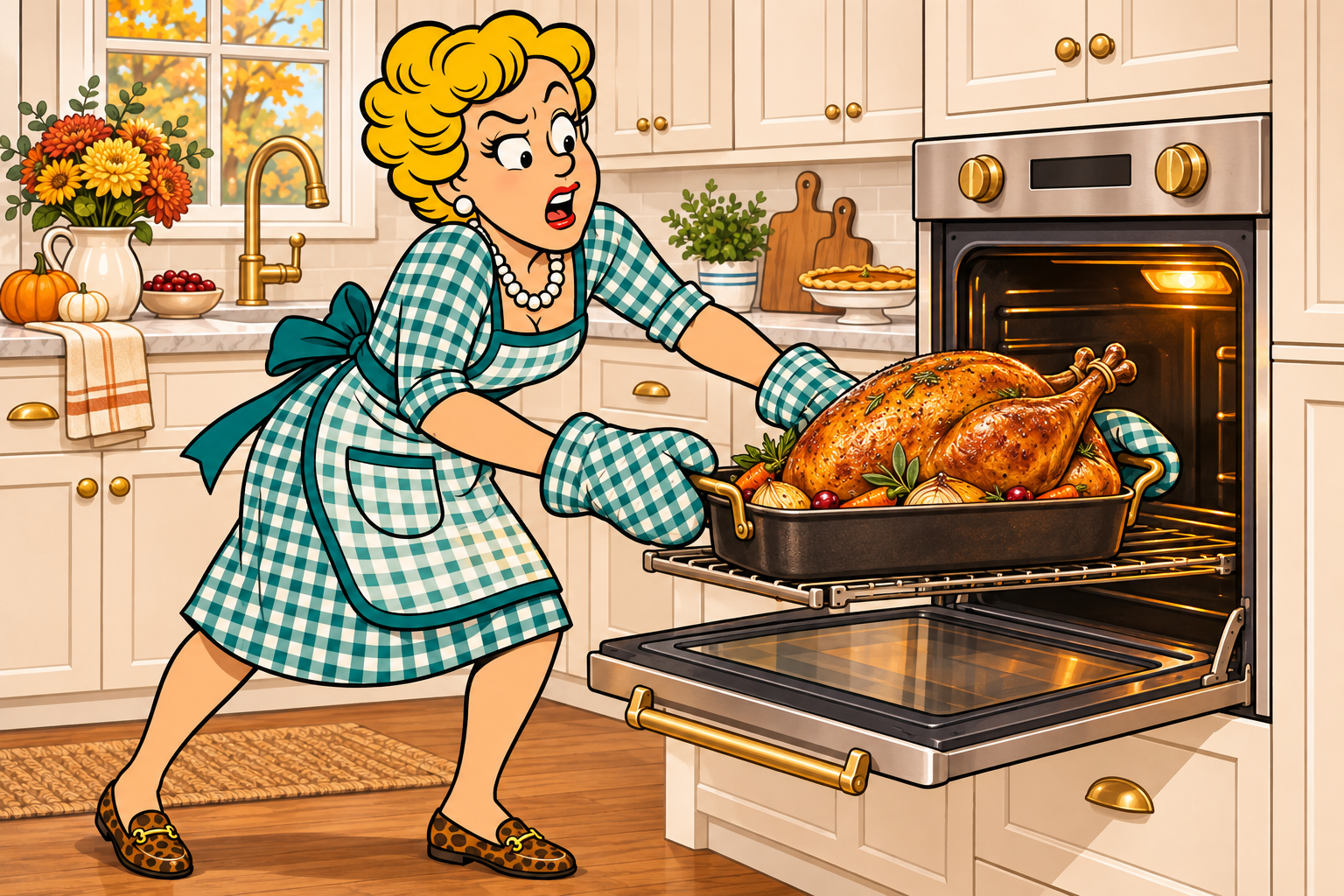
The oven door is open. The heat hits your face and fogs your glasses. You slide on the oven mitts, grab the handles of the roasting pan and lift.
And for one long second, nothing happens.
Then your forearms start to shake, the pan tips a little, and a voice in your head asks, When did this get so heavy?
Last Thanksgiving, that was me.
When was the last time something you used to lift without thinking made you stop and think?
Backup was watching football
I told you last week that I didn't cross off everything on my list by January. That's true. But I skipped over one item, because it deserved its own letter.
Fourth line down, under the pear magnet: Start lifting weights. For real this time.
I wrote "for real this time" because I'd put that exact line on a January list before. More than once. Every year the plan was the same: new gym membership on January 2, new leggings, new me.
So when I wrote it in November, I fully intended to leave it for January Mary. She's the one with the gym bag.
Then came Thanksgiving. Eighteen pounds of turkey, plus the pan, plus the juices sloshing toward the edge. I got it about two inches off the rack, set it back down and called for backup.
Backup was watching football.
He came, he lifted, we ate, and it was delicious. But that wasn't the end of it.
After dinner, my niece talked me into a card game on the living room floor. Sitting down went fine. Getting up was a different story. One hand on the coffee table, one hand on my knee, a sound I'd never made before, and a niece who politely pretended not to hear it.
Two days later, I carried the folding chairs back down to the basement. I used to take them two at a time. This time I took them one at a time and stopped halfway down the stairs to catch my breath.
Three moments in one long weekend. None of them dramatic, and all of them small enough to laugh off. I almost did.
But the turkey wasn't heavier than the year before. If anything, it was smaller. Something in me had changed, and I didn't know what.
The turkey didn't get heavier
On the Monday after Thanksgiving, I told Denise the whole story, sound effects included.
She laughed at the sound effects. Then she explained something nobody had ever explained to me.
Estrogen does a lot more than run your cycle. Your muscles have receptors for it, and it seems to help them hold on to their size and strength. As estrogen gets unpredictable in perimenopause and then declines, muscle has a harder time keeping what it has.
The Study of Women's Health Across the Nation, known as SWAN, has followed thousands of women through midlife. When researchers measured their body composition, they found that lean mass started to decline as the menopause transition began, while the rate of fat gain doubled. Those shifts continued until about two years after the final period, then leveled off.
Here's the part that made me sit up. In that same study, weight didn't speed up at the transition. It kept creeping up at the same slow pace it always had.
So the scale barely moved. Underneath it, I was quietly trading muscle for fat.
That explained my waistband. It explained why my jeans fit differently even though the number on the scale looked familiar. And it explained the turkey.
I wasn't lazy, and I wasn't imagining it. My body had been changing the rules, and nobody had handed me the new rulebook.
Muscle does more than lift turkeys
Then Denise told me about the other jobs my muscles had been doing behind the scenes.
Muscle is where your sugar goes. After a meal, your muscles take up roughly 80% of the sugar that leaves your bloodstream. Think of muscle as the biggest parking lot in town. The more spaces you have, the easier it is to park everything after a big meal. Fewer spaces, and the sugar has to circle the block. I thought about my 4 p.m. cookie and suddenly wanted more parking spaces.
Muscle talks to your bones. When a muscle pulls on a bone, the bone takes it as a signal to stay strong. Bone needs that tug, and it needs it most right now. SWAN found that bone loss begins about a year before the final period. Over ten years, women lost an average of about 10% of the bone density in their spines, and most of that loss happened in the few years around the final period.
Muscle may even help with hot flashes. In a small study from Linköping University in Sweden, women past menopause started strength training three times a week. After 15 weeks, they had about half as many moderate-to-severe hot flashes as women who kept their usual routine. Denise was clear with me: it's one small study, in women further along than I was, and the benefit had faded by the two-year follow-up. Promising, not proven. But I'll take promising.
That's when it clicked. I'd always filed strength training under body shape. Something for January, for a dress, for a "new me." It isn't. It's part of how my body handles blood sugar, protects my bones and maybe even runs its thermostat.
Strength keeps your options open. Denise says that a lot. Thinking back to that turkey, I finally understood what she meant.
January Mary had a gym plan
So, back to my list. January Mary's plan was very specific. Join the gym on January 2. Go five days a week. Be a new woman by Valentine's Day.
Here's a fun fact that let the air out of that plan. The fitness app Strava looked at millions of logged workouts and found that New Year's exercise resolutions most often start to slide by mid-January. It happens so reliably that people have given it a name: Quitter's Day.
Every year, I'd been planning to start in the busiest week of the year at the gym and quit by the middle of the month. And I had the history to prove it.
November Mary tried something different. She started small, and she started at home.
The Monday after Thanksgiving, while the leftovers warmed, I did two things at my kitchen counter:
Sit-to-stands. I stood up from a dining chair and sat back down, slowly, ten times, without using my hands. (The coffee table and I had unfinished business.)
Counter push-ups. Hands on the edge of the counter, body at a slant, ten times. (That one was for the turkey.)
That was it. About ten minutes. I did it again on Thursday.
The next week I added a third move: carrying the grocery bags in from the car the long way around the house. My neighbor asked if I was lost. I told her I was training.
By New Year's Day, I had nine sessions behind me. Nobody would have called me a weightlifter. But I could get up off the floor in one smooth move, and the Christmas decorations came up from the basement without a rest stop on the stairs.
And the research on how much it takes was the best news of all. A 2022 analysis in the British Journal of Sports Medicine pooled 16 studies. It found that 30 to 60 minutes a week of muscle-strengthening activity was linked with a 10 to 20% lower risk of dying early, and of heart disease, diabetes and cancer. Those were observational studies, so they show a link rather than proof. But look at the dose. Thirty to sixty minutes. A week.
I'd been waiting for January to find five hours a week. I needed about two sitcoms' worth.
Somewhere between the pink dumbbells and the barbell
Part of why I'd never started was that I thought I had exactly two choices.
Choice one: the little pink three-pound dumbbells. For years I'd heard that women my age should lift light, do lots of reps and be careful not to "bulk up."
Choice two: everything in my social feed. Women my age deadlifting heavy barbells and telling me that if I wasn't lifting heavy, it didn't count.
The first felt pointless. The second felt terrifying. So I picked choice three and did nothing.
Denise gently untangled all of it.
It isn't too late. A 2026 review in the Journal of Science and Medicine in Sport pooled 126 studies of more than 4,000 women, about two-thirds of them past menopause. Strength training improved strength and body composition, and the gains were about the same whether women were before or after menopause. Our muscles still respond. They just need a reason.
Bulking up isn't the real risk. Building muscle takes steady work over months. The far more common midlife problem is losing it without noticing, right up until the turkey comes out of the oven.
Heavy isn't the only door. Heavier lifting does have an edge for bone. In Australia's LIFTMOR trial, women past menopause who already had low bone density lifted heavy, under supervision, for 30 minutes twice a week for eight months. Their spine and hip bone density improved compared with women on a gentle home program, and the training didn't cause spine fractures. But those women were screened, coached and built up gradually.
For muscle, a wide range of loads works. Australia's Women's Health Education Network made this point in a 2026 position statement: heavy lifting is one evidence-based option for menopause, not the only one. The best program is the one you can start, keep doing and slowly make a little harder.
That last part matters most. The pink dumbbell isn't wrong. Staying at three pounds forever is what gives your muscles no reason to change.
You don't need January to figure out the how
Denise here, stepping in for a moment.
I hear versions of Mary's turkey moment all the time. Sometimes it's the turkey. Sometimes it's the suitcase, the grandbaby or the floor after a game of cards. And it almost always comes with the same quiet worry: Is this just what happens now?
Here's what I want you to know. It's common, it makes sense, and your body can still respond.
My own perimenopause began around 37, and like so many of you, I had to connect a lot of the dots on my own. That's a big part of why I do this work. As your coach, I can help you understand what's happening with your muscle, your bones and your hormones. I can explain why your waistband changed while the scale didn't, and what the research actually says, before you ever sit down in an exam room.
Your doctor's role is different and just as important: diagnosis, prescriptions and deciding what's safe for your health history, including whether a bone density scan makes sense for you. If you have osteoporosis, joint pain, a heart condition or a recent injury, get the green light from your provider before you add weight, and consider a physical therapist to help with form. And if you notice leaking, heaviness or pelvic pain when you lift, a pelvic health physical therapist is worth a visit.
You don't need a new year. You need a reason and a sturdy chair.
Two small things you can do this Thanksgiving week:
Take your own Thanksgiving strength test. Notice three moments this week: lifting the heaviest dish, getting up off the floor or a low couch, and carrying something up or down the stairs. Jot them in your three columns from last week. No judgment, just information. The holidays are still clues.
Do the counter two-step, twice. Ten slow sit-to-stands from a sturdy chair and ten counter push-ups, on two days this week. While the pie bakes is perfect. Stop if anything hurts sharply, and if any of the conditions above apply to you, check in with your provider first.
This Thanksgiving
The turkey goes in on Thursday morning. Twenty pounds this year, because my daughter is bringing her new boyfriend and I've been warned that he eats.
When it comes out, I'm lifting it myself.
Not because I've become a powerlifter. I haven't. I lift twice a week, mostly at home, a little heavier than I did last winter. In February, once Quitter's Day had come and gone and the gym was quiet again, I paid a trainer to check my form. That's the whole secret.
Here's what I know now that I didn't know last Thanksgiving. Midlife strength isn't really about the turkey. It's about the yes. Yes to the card game on the floor. Yes to the spring hike with my sister. Yes to carrying my own bag, and maybe someone else's.
January Mary wanted to get strong someday. November Mary just got started.
So, friend to friend: what do you want to keep saying yes to, ten years from now?
— Mary
Start here
If you've been noticing changes in midlife and wondering how they fit together, book a Hormone Clarity Call with me. We'll talk through what you've been noticing, from the