
Denise Stegall · November 3, 2026
Menopause and Sleep: Why the Time Change Has You Wide Awake at 3 a.m.
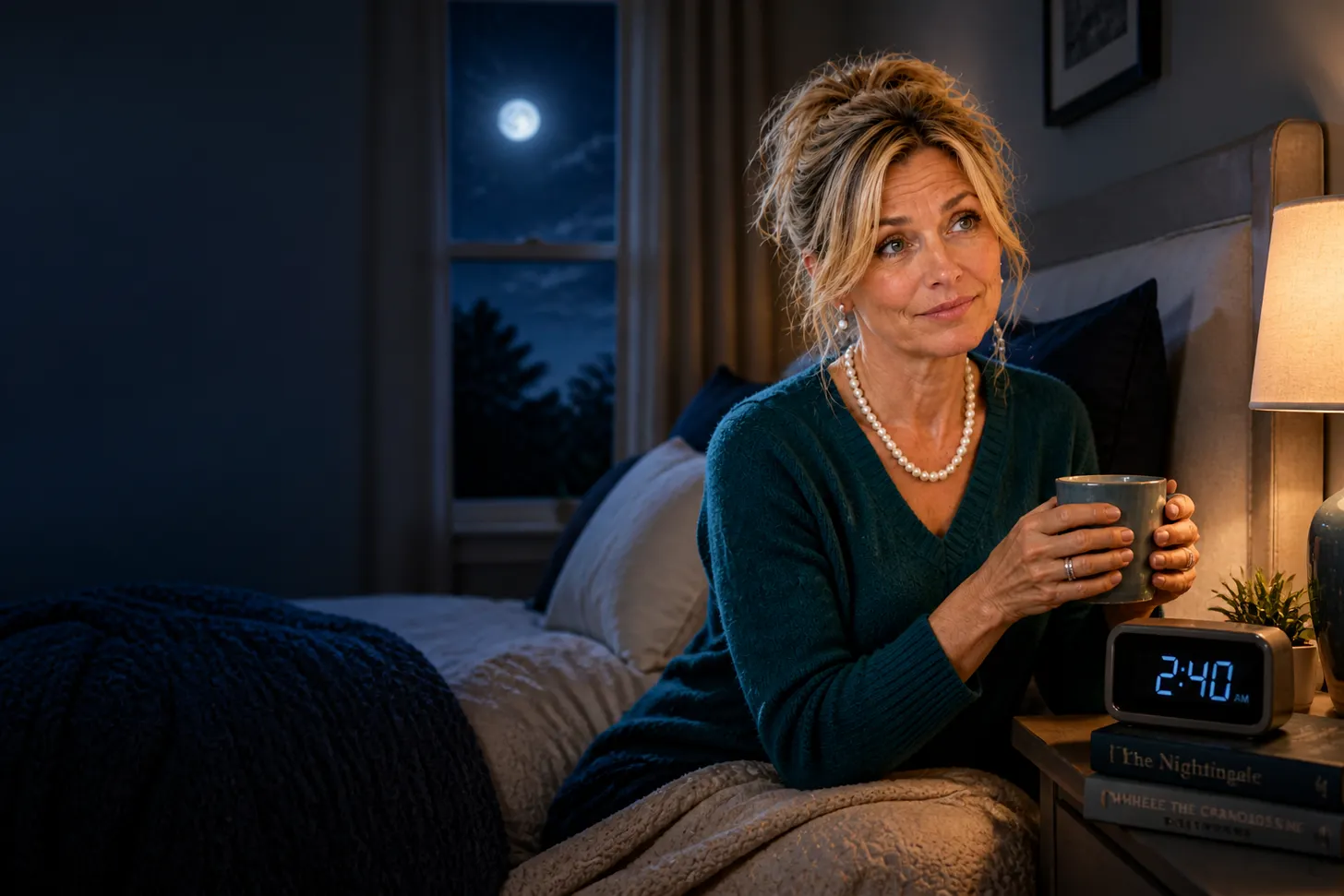
Waking at 2 or 3 a.m. is one of the most common sleep complaints in perimenopause and menopause, and the end of daylight saving time can make it worse. Here's how your body clock, cortisol and changing hormones interact, what the research shows, and what you can do this winter.
Maybe one of these sounds familiar:
You fall asleep easily, then wake at 2:30 a.m. with your mind fully online.
Now that it's dark before dinner, you're fading by 8:30 and in bed by 9, yet you're sleeping worse, not better.
You wake up hot, kick off the covers and lie there for an hour.
By January your clothes fit differently, even though you haven't changed how you eat or move.
These experiences are connected. Something I hear from women every November is, "I'm exhausted, but I can't stay asleep." The explanation usually involves three systems at once: your circadian rhythm, your cortisol rhythm and the hormonal shifts of midlife.
Why do I wake up at 3 a.m. during perimenopause and menopause?
Night waking is the signature sleep problem of the menopause transition. In the Study of Women's Health Across the Nation (SWAN), waking several times a night was the most common sleep complaint, and it became more frequent as women moved through the transition. Across studies, roughly 40% to 56% of women in the transition and after menopause report sleep difficulties, and about 26% have symptoms severe enough to qualify as insomnia.
Several factors tend to stack up in the early morning hours:
Hot flashes and night sweats. In a sleep-lab study of perimenopausal women, 69% of objectively measured hot flashes were tied to an awakening, and hot-flash-related wake time made up about a quarter of total time awake. Not every awakening starts with a hot flash, though; sometimes the waking comes first.
Declining progesterone. Progesterone is converted into allopregnanolone, a compound that enhances the brain's main calming system (GABA-A receptors). As progesterone falls, that calming support weakens.
Cortisol's natural rise. Cortisol is lowest around midnight and rises through the second half of the night, so the 2-to-4 a.m. window is when your body is already starting its climb toward morning.
Breathing changes. The risk of obstructive sleep apnea rises after menopause, and it can fragment sleep even without obvious snoring.
How does daylight saving time affect sleep?
Your circadian rhythm is run by a master clock in the brain that resets daily, mainly in response to light. Morning light signals "day," and darkness signals "wind down."
The American Academy of Sleep Medicine's 2023 position statement recommends eliminating seasonal clock changes in favor of permanent standard time, which it says aligns best with human circadian biology.
The fall change is often treated as harmless because we "gain" an hour, but it isn't neutral. A Danish registry study of 185,419 hospital contacts for depression found an 11% increase in new depressive episodes after the shift to standard time, an effect that faded over about 10 weeks. The authors pointed to the sudden earlier sunset as the likely explanation. This study measured diagnosed depression, not sleep, but it shows the transition affects how people feel.
Longer nights also change melatonin. Research from the National Institute of Mental Health shows that in many people, the nightly window of melatonin release lengthens when nights are longer, although people living with modern indoor lighting vary in how strongly they respond. That helps explain why you may feel sleepy far earlier in November. In the first several days after the change, there's also simple arithmetic: 9 p.m. on the clock feels like 10 p.m. to your body.
Is going to bed earlier a good idea in winter?
Usually not by much. Sleep depends partly on sleep drive, a pressure to sleep that builds the longer you're awake. Clinicians who teach cognitive behavioral therapy for insomnia (CBT-I) describe trouble staying asleep as running out of sleep drive in the middle of the night, and they list going to bed too early as one of the habits that works against sleep.
Going to bed 90 minutes early can mean less sleep drive banked at lights-out, which raises the odds of waking in the small hours. A better approach is to keep your wake time steady, let bedtime shift by 15 to 30 minutes at most, and start your wind-down earlier instead of turning out the lights earlier.
What does cortisol have to do with waking up at night?
Cortisol isn't only a stress hormone. It's also your body's daily wake-up signal, with a predictable rhythm: a quiet, low period centered around midnight, a rise through the second half of the night and a peak shortly after waking.
A University of Chicago review explains several connections that matter in midlife:
Awakenings during the night are consistently followed by a brief rise in cortisol.
With age, the quiet low-cortisol period gets shorter, the low point sits higher and the overnight rise begins earlier, and the shortening of that quiet period appears even sharper in women.
Higher cortisol in the evening is linked with more awakenings the following night.
Sleep loss feeds the cycle. In one study, a single night of restricted sleep raised evening cortisol the next day by 37% and delayed its nightly quiet period by about an hour. That study involved a small group of young men, so the exact number may not apply to midlife women, but the pattern has been replicated in other research.
Menopause adds its own layer. The Seattle Midlife Women's Health Study found that cortisol levels rise in some women during the late menopause transition, and earlier lab studies observed cortisol rising alongside hot flashes.
One caution: cortisol changes hour by hour, so a single reading captures only one moment in a moving rhythm. If you're curious about testing, talk with your provider about what a given test can and can't tell you.
Can poor sleep cause weight gain in menopause?
Poor sleep is one of several factors that can make midlife weight harder to manage. It's rarely the only one.
Insulin. In a randomized trial funded by the National Institutes of Health, women whose sleep was reduced by about 1.5 hours a night for six weeks saw insulin resistance rise by 14.8%, and by up to 20.1% in postmenopausal women. The effect didn't depend on weight change, and it reversed when normal sleep resumed.
Appetite. In a small study of young men, two nights of short sleep lowered leptin, raised ghrelin and increased hunger, especially for carbohydrate-dense foods.
Body clock timing. When people ate and slept far out of sync with their internal clocks in a lab setting, leptin fell, glucose rose despite more insulin, and the daily cortisol rhythm reversed. That was an extreme 12-hour mismatch, not a one-hour clock change, but it shows how strongly timing matters to metabolism.
Cortisol and fat distribution. Women with more central fat released more cortisol in response to repeated stress in a Yale study. It was cross-sectional, so it can't prove cause and effect.
The menopause transition itself. SWAN found that at the start of the transition, the rate of fat gain doubled and lean mass began to decline, continuing until about two years after the final period, even though the pace of overall weight gain didn't speed up.
The takeaway: if your weight shifts every winter without a change in your eating or activity, sleep timing and cortisol are worth a closer look, alongside insulin, muscle and hormones.
Will hormone therapy help sleep problems in menopause?
For some women, yes, especially when hot flashes and night sweats are driving the awakenings. The Menopause Society's 2022 hormone therapy position statement, published under its former name, the North American Menopause Society, calls hormone therapy the most effective treatment for hot flashes and night sweats, and notes that for most healthy women under 60 or within 10 years of menopause, the benefits outweigh the risks. Treatment should be individualized.
The evidence on sleep specifically is more mixed:
In SWAN, postmenopausal women using hormone therapy generally reported less trouble falling and staying asleep, though the benefit wasn't consistent across every group.
A meta-analysis of randomized trials found that micronized progesterone improved several sleep measures, mostly in postmenopausal women, but results varied between studies and some trials also included estradiol.
In a pooled analysis of the NIH-funded MsFLASH trials in women with hot flashes, CBT-I improved insomnia symptoms more than low-dose estradiol or any other option tested.
Hormone therapy is a personal decision best made with a menopause-informed provider who knows your history.
What can I do to sleep better after the time change?
Get outdoor light within an hour of waking, for 10 to 30 minutes. Even a cloudy morning outside is far brighter than indoor lighting.
Anchor your wake time, including weekends.
Shift bedtime gradually, 15 to 30 minutes at most, and wind down earlier with dim lights and calm activities.
Use the 20-minute rule. If you can't fall back asleep in about 20 minutes, get up, go somewhere dim and quiet, and return when you feel sleepy.
Keep the bedroom cool to reduce night-sweat awakenings.
Watch evening alcohol and late, heavy meals, which often disrupt the second half of the night.
Ask about CBT-I, the most effective non-medication treatment studied for insomnia in midlife women.
Find your pattern
If you're ready to connect your symptoms to what may be happening hormonally, the Hormone Clarity Tool is a good next step. It doesn't diagnose or replace your healthcare provider. It helps you see your patterns and bring better questions to your next appointment.
Connect the dots. Understand your body. Know what to do next.
FYI-References
Rishi MA, Cheng JY, Strang AR, et al. Permanent standard time is the optimal choice for health and safety: an American Academy of Sleep Medicine position statement. J Clin Sleep Med. 2024;20(1):121–125.
Hansen BT, Sønderskov KM, Hageman I, Dinesen PT, Østergaard SD. Daylight savings time transitions and the incidence rate of unipolar depressive episodes. Epidemiology. 2017;28(3):346–353.
Wehr TA. Melatonin and seasonal rhythms. J Biol Rhythms. 1997;12(6):518–527.
Balbo M, Leproult R, Van Cauter E. Impact of sleep and its disturbances on hypothalamo-pituitary-adrenal axis activity. Int J Endocrinol. 2010;2010:759234.
Leproult R, Copinschi G, Buxton O, Van Cauter E. Sleep loss results in an elevation of cortisol levels the next evening. Sleep. 1997;20(10):865–870.
Baker FC, de Zambotti M, Colrain IM, Bei B. Sleep problems during the menopausal transition: prevalence, impact, and management challenges. Nat Sci Sleep. 2018;10:73–95.
de Zambotti M, Colrain IM, Javitz HS, Baker FC. Magnitude of the impact of hot flashes on sleep in perimenopausal women. Fertil Steril. 2014;102(6):1708–1715.
Woods NF, Mitchell ES, Smith-DiJulio K. Cortisol levels across the menopausal transition: observations from the Seattle Midlife Women's Health Study. Menopause. 2009;16:708–718.
Zuraikat FM, et al. Chronic insufficient sleep in women impairs insulin sensitivity independent of adiposity changes: results of a randomized trial. Diabetes Care. Published online November 2023. doi:10.2337/dc23-1156.
Spiegel K, Tasali E, Penev P, Van Cauter E. Sleep curtailment in healthy young men is associated with decreased leptin levels, elevated ghrelin levels, and increased hunger and appetite. Ann Intern Med. 2004;141(11):846–850.
Scheer FAJL, Hilton MF, Mantzoros CS, Shea SA. Adverse metabolic and cardiovascular consequences of circadian misalignment. Proc Natl Acad Sci USA. 2009;106(11):4453–4458.
Epel ES, McEwen B, Seeman T, et al. Stress and body shape: stress-induced cortisol secretion is consistently greater among women with central fat. Psychosom Med. 2000;62(5):623–632.
Greendale GA, Sternfeld B, Huang M, et al. Changes in body composition and weight during the menopause transition. JCI Insight. 2019;4(5):e124865.
The North American Menopause Society. The 2022 hormone therapy position statement of The North American Menopause Society. Menopause. 2022;29(7):767–794.
Kravitz HM, Zhao X, Bromberger JT, et al. Sleep disturbance during the menopausal transition in a multi-ethnic community sample of women. Sleep. 2008;31(7):979–990. Summary: Rush University Medical Center news release.
Nolan BJ, Liang B, Cheung AS. Efficacy of micronized progesterone for sleep: a systematic review and meta-analysis of randomized controlled trial data. J Clin Endocrinol Metab. 2021;106(4):942–951.
Guthrie KA, Larson JC, Ensrud KE, et al. Effects of pharmacologic and nonpharmacologic interventions on insomnia symptoms and subjective sleep quality in women with hot flashes: a pooled analysis of individual participant data from four MsFLASH trials. Sleep. 2018.
Cleveland Clinic Sleep Disorders Center. CBT-I first follow-up: patient education.
Cleveland Clinic. Sleep apnea is especially dangerous for women's hearts.